
|
Local View: Think flowers, not corruption or cocaine, at mention of Colombia |
 |
By John Freivalds
Duluth News Tribune
Published 5/12/2025
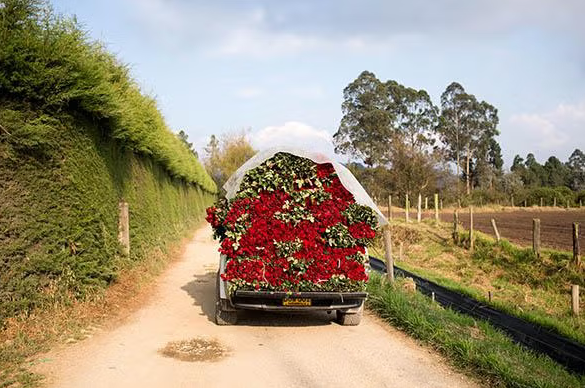
Everywhere, it seems, cut flowers are for sale, from gas stations to supermarkets to drugstores and elsewhere. Such sales used to be the exclusive domain of florists. A big reason for the change happened right before my eyes in Colombia.
This was when I was in the Peace Corps 50 years ago (yikes!), and the flower boom took off. My job was to get vegetable growers around Bogotá, the capital, to sell directly to retail stores without going through a middleman. Small-scale stuff compared to what eventually happened.
The origins of Colombia’s export flower industry can be attributed to Edgar Wells, a Colombian of English descent. A floriculture hobbyist-turned-entrepreneur, Wells was intent on making Colombia a producer and exporter of cut flowers. In fact, he once compared the Colombian flower industry to the legend of El Dorado, the mythical Indian city in Colombia of unimaginable riches.
“After 400 years,” Wells once commented, “the true riches of El Dorado have been discovered. … (Flowers are) a permanent source of riches for all Colombians, for all time.”
He had four other investors in Floramerica. One was a firm for which I eventually worked.
Roses, carnations, Dianthus caryophyllus, alstroemerias, hydrangeas, and chrysanthemums are still among the most important exported Colombian flowers. Approximately 17,300 acres are utilized for flower production today in the country. Many of its nurseries are greater than 124 acres, and most remain family-owned and -operated.
As one exporter sized it up: “The relationship with the U.S. market has become very close, with the entire distribution chain to the U.S. closely aligned with production in Colombia. There is a fully integrated system in place, which is important to consider before making any decisions that could harm both sides. … No matter how small the town, you’ll likely find Colombian flowers available for purchase.”
Alas, news from Colombia today is mostly about violence, drug trafficking, migrants, and human trafficking. Despite all that gripping the country and ongoing corruption, Colombia flower exports grow as logistics improve. And its flower industry received a jolt in 1991 when the U.S. dropped tariffs on flowers. The logic was that if Colombians can export more flowers, they will not export cocaine.
Most consumers do not know where the carnations they buy come from. But consumers do know about Colombian coffee and are fans of the fictional smiling peasant Juan Valdez selling it. (The New York ad firm Doyle Dain Bernbach invented Valdez in 1959, just like General Mills used a Minneapolis agency in 1921 to invent Betty Crocker.)
Researchers discovered that a 9,000-foot plateau outside of Bogotá has as much sun as Colorado, maybe even more, and the same desirable cool evenings. While growers in the U.S. have to contend with wintertime heating, driving up the cost of growing flowers, temperatures down near the equator are much more moderate.
This year, on Oct. 18, the 50th anniversary of the first Colombian flower exports to the United States will be marked — while the entire industry is now up in the air with new tariffs proposed. I don’t know if I am ready to buy paper flowers.
John Freivalds of Orono, Minnesota, is a commodities broker, the author of six books, the retired honorary consul of Latvia in Minnesota, and a regular contributor to the News Tribune Opinion page. His website is jfamarkets.com.